Contents
- What This Page Claims
- Released Artifacts
- Experiment Timeline
- Test Coverage Snapshot
- Complete Candidate Lists
- Source Model And RYS Build
- Layer-Window Selection
- Quantization Survival
- Runtime Profile
- MTP And Speed Work
- Rejected Or Non-Default Variants
- Practical Agent Tests
- Implementation Footnotes
- Evidence Ledger
What This Page Claims
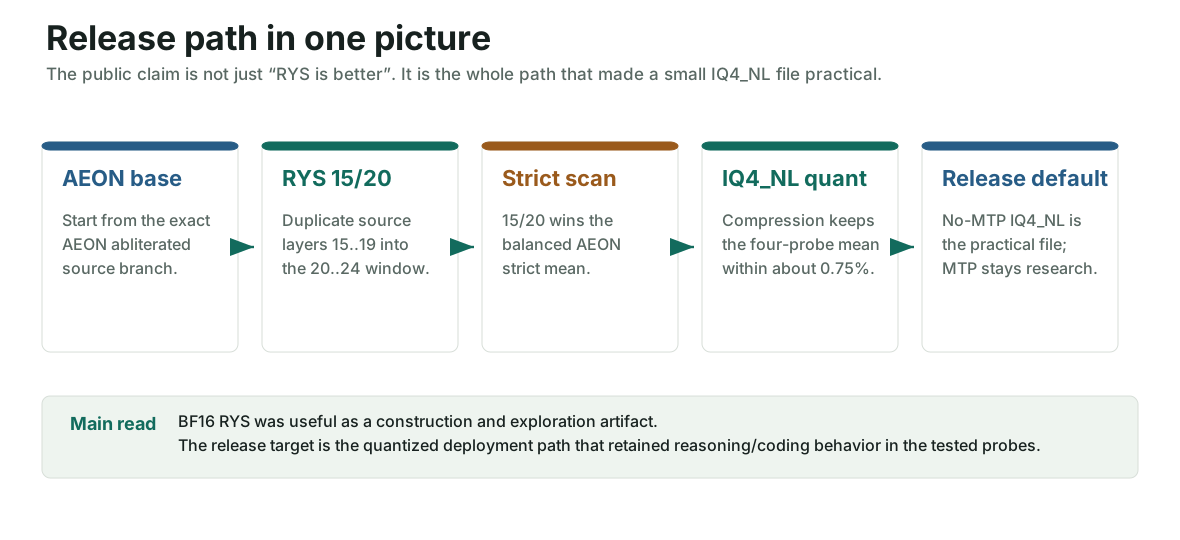
This page is intentionally written as a record, not a leaderboard page. It explains why the release default became the non-MTP IQ4_NL GGUF and where the evidence is strong, weak, or mixed.
Project Positioning
The broader goal of this model series is practical local work: capable, functional models that fit realistic hardware and can simply get tasks done. Built on the AEON uncensored base, this release is meant to stay low-friction: less lecturing, less getting in the way, and more focus on completing the task in front of it.
RYS and IQ4_NL are the practical part of that goal: preserving useful reasoning and coding behavior in a compact form factor. One 24 GB-class GPU can be enough for a serious local worker. More GPUs naturally mean more independent workers in parallel, not a different claim about one model instance.
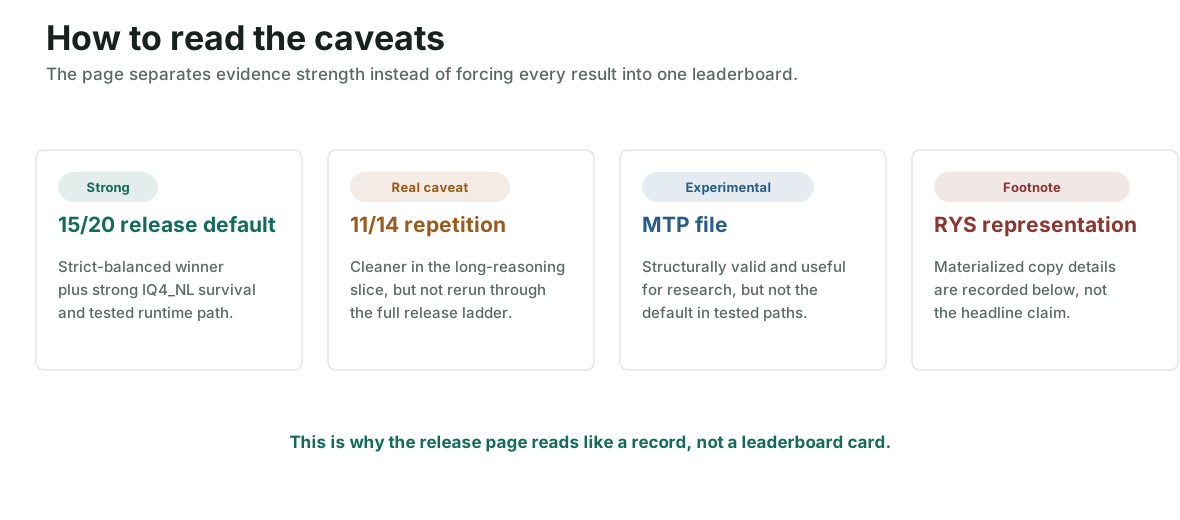
Claimed
On the mixed BF16-vs-IQ4_NL snapshot, this RYS 15/20 branch lost less than 1% relative mean score after compression to the released practical GGUF.
Claimed
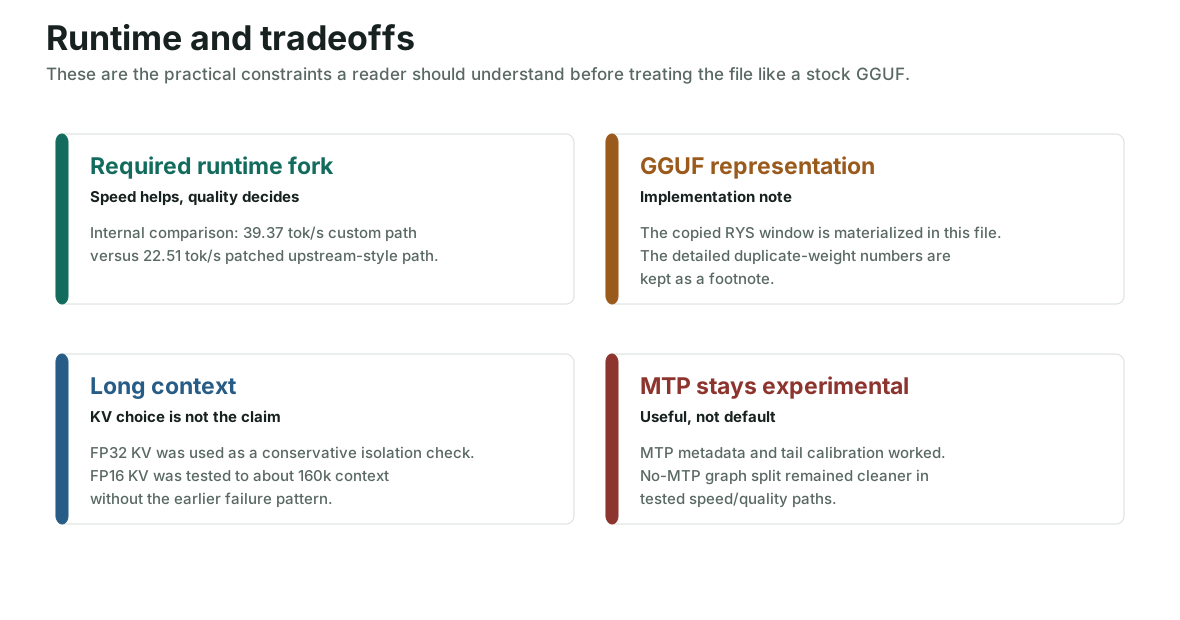
The custom ik-llama fork is the intended runtime path. It also measured faster in the internal comparison, 39.37 tok/s versus 22.51 tok/s for the patched upstream-style comparison, but that speed note is secondary to preserving quality in the Q4_NL file.
Not Claimed
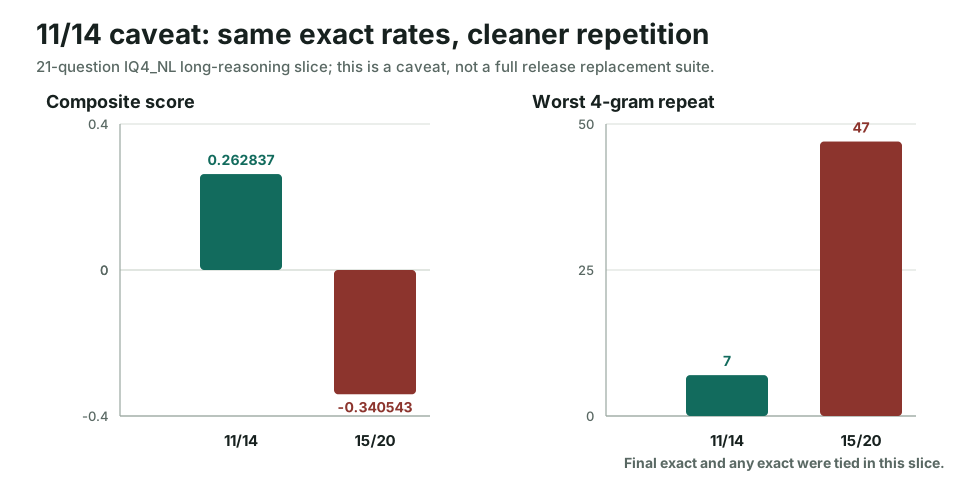
15/20 is not presented as universally best. A later 11/14 long-reasoning comparison was cleaner on repetition, and that remains an important caveat.
Released Artifacts
The public Hugging Face repo contains the practical inference file, an experimental MTP file, a BF16 GGUF reference, and the BF16 safetensors folder for continued work.
| File | Purpose | Size | Decision |
|---|---|---|---|
Qwen3.6-27B-AEON-RYS-MaxThinkCoder-IQ4_NL-ik-llama-custom-mixed.gguf |
Main non-finetuned inference artifact. | 16,554,834,080 bytes | Default release file. |
Qwen3.6-27B-AEON-RYS-MaxThinkCoder-SpeedBoosted-IQ4_NL-MTP-Experimental.gguf |
MTP-capable IQ4_NL artifact with MTP-tail imatrix coverage. | 16,794,473,728 bytes | Experimental; not the default. |
Qwen3.6-27B-AEON-RYS-MaxThinkCoder-BF16.gguf |
Source-quality GGUF reference for inspection, conversion, and comparison. | 57,597,296,608 bytes | Exploration artifact. |
bf16-safetensors/ |
HF-format checkpoint for Transformers, LoRA, SFT, continued training, or conversion work. | 11 shards | Training/workflow artifact. |
Decision
For normal users, the intended file is the non-MTP IQ4_NL GGUF. The BF16 files exist so people can inspect or continue the work; they are not the small-form deployment claim.
Experiment Timeline
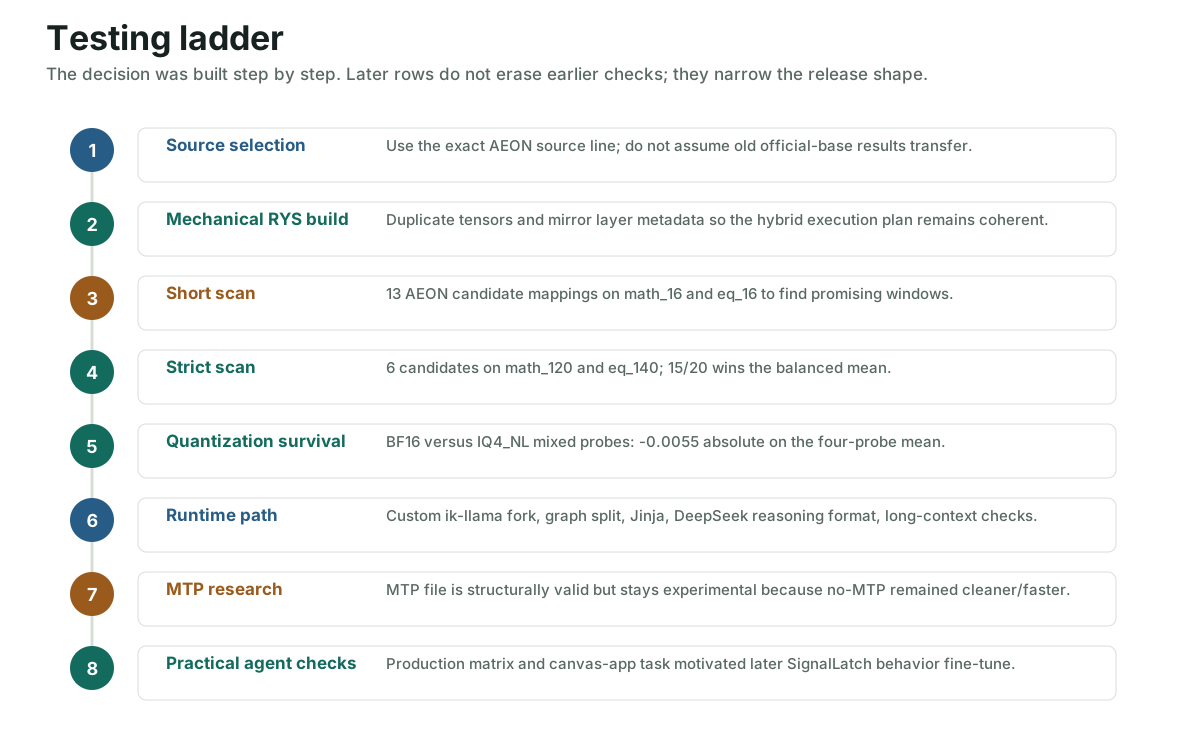
The release moved through source selection, RYS construction, strict scanning, quantization screening, runtime work, and practical validation. Later fine-tune work built on this base, but is separate from the non-finetuned record here.
1. Source Branch
Use AEON-7/Qwen3.6-27B-AEON-Ultimate-Uncensored as the source branch instead of the earlier official-base line or other abliterated candidates.
2. RYS Build
Build safetensors-first RYS checkpoints with correct tensor remapping and per-layer metadata remapping for Qwen3.6 hybrid attention.
3. Strict Window Scan
Compare candidate RYS windows against AEON baseline on strict math and EQ validation files. Select 15/20 as the balanced winner.
4. Quantization Screen
Convert to GGUF, build imatrix calibration, quantize to IQ4_NL, and compare BF16 against the quantized release candidate.
5. Runtime Work
Patch and package the ik-llama fork for the custom mixed GGUF layout, Qwen3.6 hybrid handling, graph split, Jinja, and DeepSeek reasoning format.
6. Release Decision
Publish the non-MTP IQ4_NL as the default, keep MTP as experimental, keep BF16 as exploration/reference, and document known caveats.
Test Coverage Snapshot
This is the compact count of the evidence behind the release. The public values used for the argument are reproduced on this page; the evidence ledger gives provenance filenames.
| Stage | Coverage | What It Answered | Decision Impact |
|---|---|---|---|
| Early AEON short scan | 13 candidate mappings across math_16 and eq_16. | Which windows looked promising before the strict pass? | Exploratory only; not final selection basis. |
| AEON strict scan | 6 candidate mappings across math_120 and historical eq_140 files. | Which RYS window had the best balanced strict score? | Selected 15,20. |
| 15/20 BF16 vs IQ4_NL | Four mixed probes: math_16, eq_16, math_4, gsm8k_5; 41 prompt items total. | Did the release quant survive compression? | Confirmed IQ4_NL as the practical target. |
| 11/14 quant caveats | Reasoning slice plus no-think math/EQ quant comparison files. | Was 11/14 obviously better after quantization? | No; it was promising but volatile and not strict-balanced winner. |
| Long fair comparison | 2 IQ4_NL branches, 21 numeric questions, 2048-token reasoning budget. | Did 15/20 have repetition weaknesses against 11/14? | Yes; documented as a real caveat. |
| Mixed-Q8 probe | 2 quant variants, 9-item quick paired eval. | Would protecting the RYS window in Q8 improve the default? | No replacement. |
| MTP work | MTP-tail imatrix, 512/2048 quality checks, short and long speed matrices. | Should the MTP file become the default? | No; keep experimental. |
| Practical agent checks | Base row from the 5-task production matrix, plus the AEON RYS attempt/retry rows from a later 5-run canvas comparison. | Could the compressed model act as a coding-agent base? | Yes with caveats. SignalLatch and Unsloth comparison rows are downstream context, not part of this base-release claim. |
Spreadsheet Source
The chart data is collected into an OnlyOffice workbook: qwen36_aeon_rys_stats.xlsx. It contains the short scan, strict scan, quantization snapshot, 11/14 long-reasoning comparison, MTP speed notes, and duplicate-window cost sheet.
Complete Candidate Lists
The first version of this page summarized the scan coverage and listed the decision rows, but did not spell out every tested mapping. This section is the explicit candidate appendix from the AEON scan files.
Single-Layer Note
The early short scan contains one true single-layer duplication candidate: blocks:20,21, which duplicates source layer 20 only. The file named aeon_single_blocks_15_20_math120.pkl is misleadingly named for this question: it contains one entry for the 15,20 block candidate, not a full single-layer sweep.
| Early short-scan candidate | math_16 | eq_16 | Mean | Read |
|---|---|---|---|---|
blocks:24,32 | 0.821109 | 0.714006 | 0.767558 | Best short-scan mean; not final strict winner. |
blocks:15,20 | 0.818587 | 0.712340 | 0.765463 | Strong short-scan candidate; later strict-balanced winner. |
blocks:11,14 | 0.802940 | 0.715609 | 0.759275 | Strong math/reasoning branch, later caveated. |
blocks:31,34 | 0.790785 | 0.713317 | 0.752051 | Close strict-scan runner-up later. |
blocks:30,35 | 0.800002 | 0.701506 | 0.750754 | Official-base winner did not transfer as AEON winner. |
blocks:0,0 | 0.794387 | 0.706506 | 0.750447 | AEON baseline. |
blocks:11,14;30,35 | 0.771005 | 0.709006 | 0.740006 | Two-window mesh; did not beat simpler candidates. |
blocks:15,27 | 0.756966 | 0.714423 | 0.735695 | Wider mid-window candidate. |
blocks:28,36 | 0.766733 | 0.700577 | 0.733655 | Late-window candidate. |
blocks:9,17 | 0.730846 | 0.723526 | 0.727186 | Good EQ, weaker math. |
blocks:30,34 | 0.713382 | 0.716506 | 0.714944 | Late-window candidate. |
blocks:8,17 | 0.664031 | 0.724776 | 0.694403 | High EQ but poor math balance. |
blocks:20,21 | 0.680363 | 0.703526 | 0.691944 | Only true single-layer duplication candidate in this short scan. |
| Strict-scan candidate | math_120 | eq_140 | Mean | Decision role |
|---|---|---|---|---|
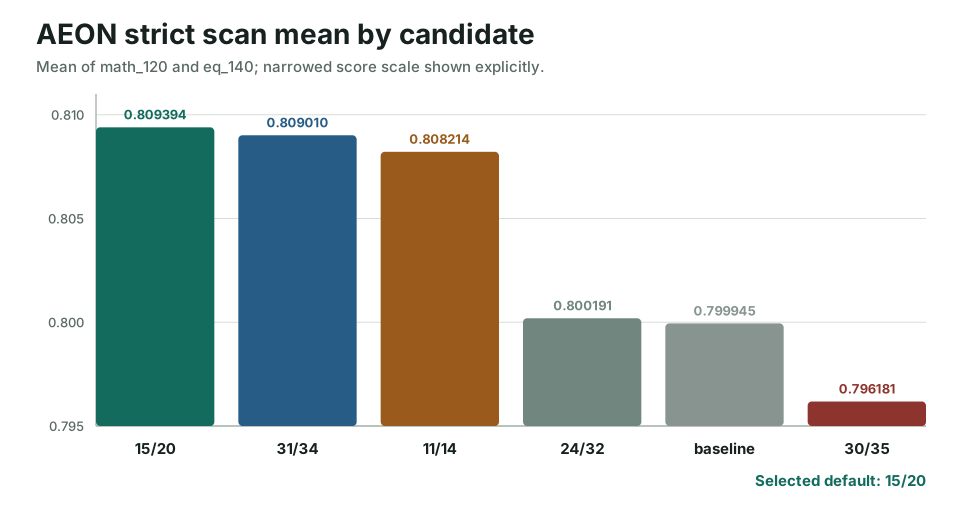
blocks:15,20 | 0.971441 | 0.647347 | 0.809394 | Winner. |
blocks:31,34 | 0.977269 | 0.640750 | 0.809010 | Very close runner-up. |
blocks:11,14 | 0.981498 | 0.634929 | 0.808214 | Best strict math, not combined winner. |
blocks:24,32 | 0.971823 | 0.628559 | 0.800191 | Near baseline. |
blocks:0,0 | 0.970181 | 0.629710 | 0.799945 | AEON baseline. |
blocks:30,35 | 0.964841 | 0.627521 | 0.796181 | Official-base winner, not AEON winner. |
Decision From The Full List
The page should not imply that every possible single-layer duplication across all 64 layers was run. The documented evidence supports: 13 early AEON short-scan mappings, 6 strict AEON mappings, one true single-layer candidate in the short scan, and a separate single-entry strict file for 15,20.
Source Model And RYS Build
The source branch for this release is AEON-7/Qwen3.6-27B-AEON-Ultimate-Uncensored. The RYS operation was a checkpoint transformation: duplicate a trained layer window and insert it back into the stack.
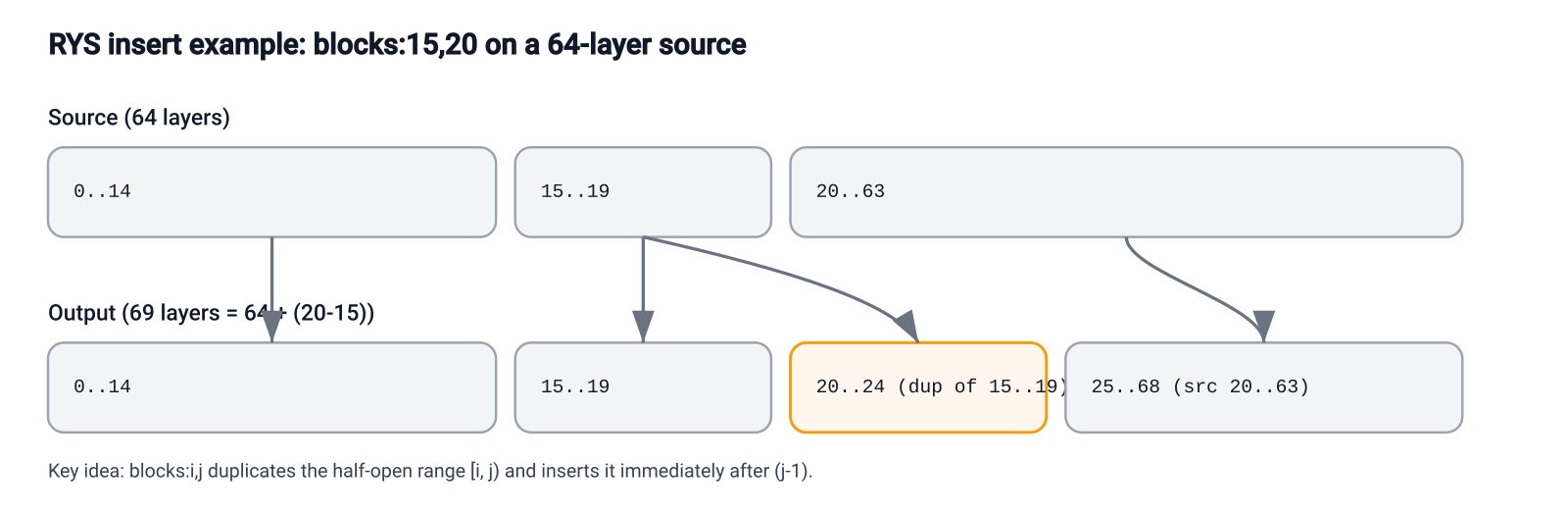
blocks:15,20, source layers 15..19 are duplicated after source layer 19. Output layers 20..24 are the copied window, and source layer 20 resumes at output layer 25.Build Rule
Every output layer must copy its weights and execution metadata from the same source layer. For Qwen3.6 hybrid models, remapping text_config.layer_types with the same output-to-source map was execution-critical.
Failure Mode
A broken RYS checkpoint can load and still generate badly. The key trap was treating the copied tensors and the per-layer execution plan as separate ledgers.
Layer-Window Selection
The selected window was not chosen because it had the highest score on every possible slice. It was chosen because it won the balanced AEON strict scan and later survived the practical Q4_NL compression screen better than the stronger math-leaning branch.
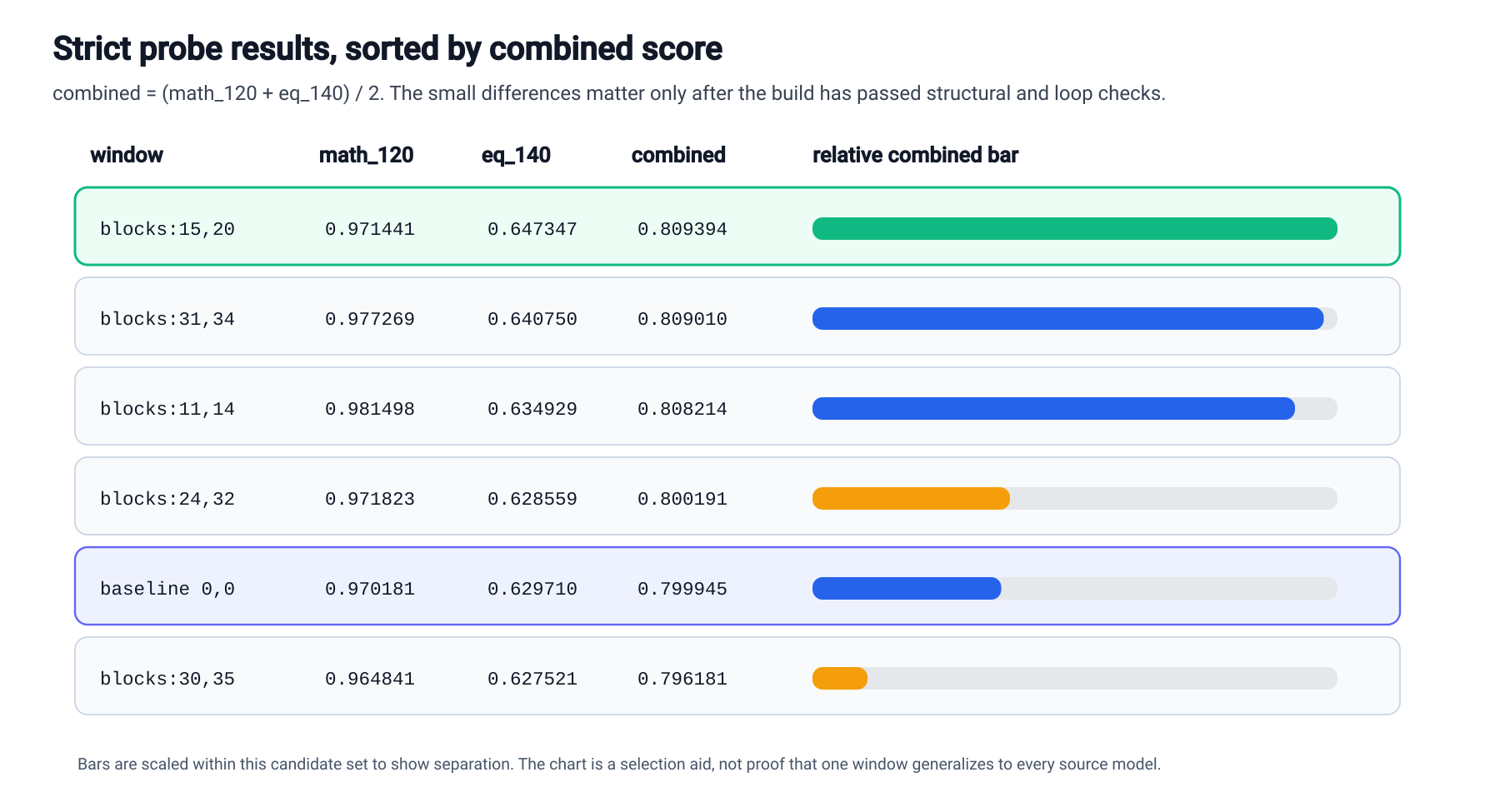
| Spec | math_120 | eq_140 | Combined | Delta vs AEON baseline | Read |
|---|---|---|---|---|---|
blocks:15,20 | 0.971441 | 0.647347 | 0.809394 | +1.181% | Best balanced strict candidate. |
blocks:31,34 | 0.977269 | 0.640750 | 0.809010 | +1.133% | Very close second. |
blocks:11,14 | 0.981498 | 0.634929 | 0.808214 | +1.034% | Best strict math, not combined winner. |
blocks:24,32 | 0.971823 | 0.628559 | 0.800191 | +0.031% | Near baseline. |
blocks:0,0 | 0.970181 | 0.629710 | 0.799945 | baseline | AEON baseline. |
blocks:30,35 | 0.964841 | 0.627521 | 0.796181 | -0.471% | Official-base winner, not AEON winner. |
Final Materialized 15/20 Check
After the materialized 15/20 artifact was built, strict checks recorded 0.983317798162 on artifact_15_20_strict_math120.pkl with 120/120, and 0.647756674780 on artifact_15_20_strict_eq140.pkl with 139/139. Combined: 0.815537236471.
Short Scan Caveat
The earlier 13-candidate short scan was not the final selection basis. In that short math_16 + eq_16 view, 24,32 was slightly higher than 15,20, so the release choice depends on the stricter balanced scan plus quantization survival.
Decision
Select 15,20 for the AEON release branch because it had the best balanced strict result. Keep 11,14 in mind as a math-leaning research branch, not the default release target.
Quantization Survival
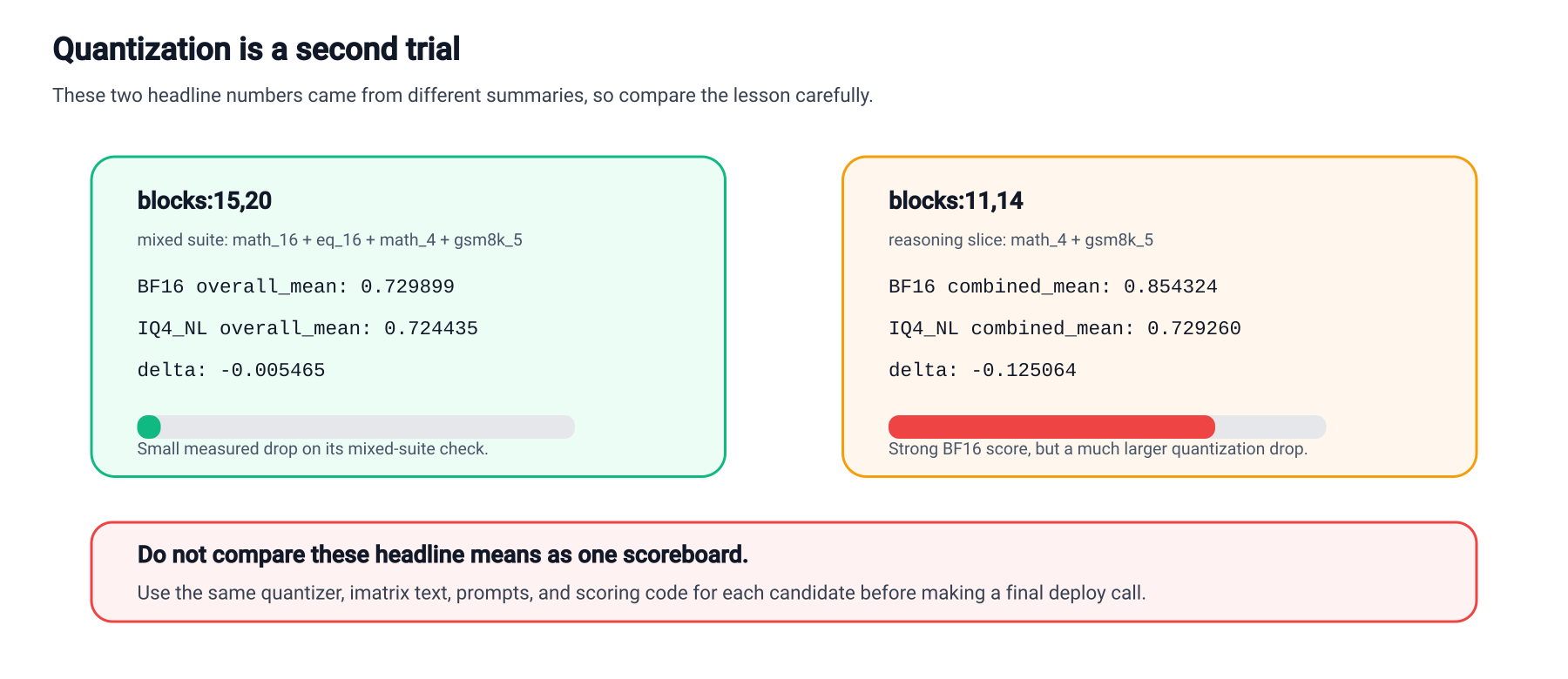
This is the main reason the public release exists as a Q4-class model. The RYS BF16 did not produce a huge headline gain by itself. The useful result was that the selected branch held up unusually well after compression.
| Probe | RYS BF16 | Released IQ4_NL | Change |
|---|---|---|---|
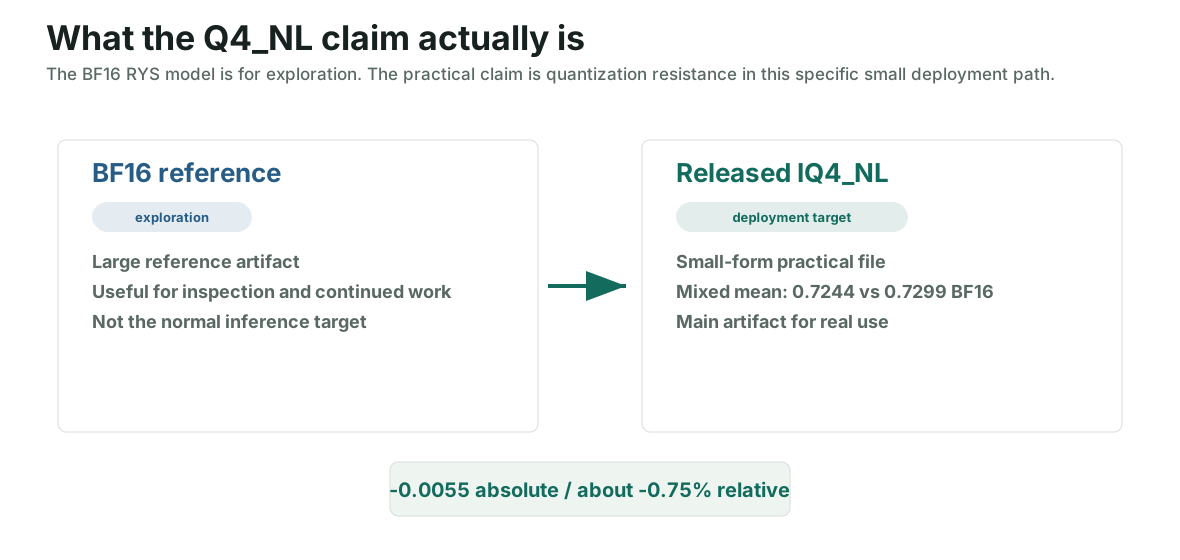
| Mixed four-probe mean | 0.729899 | 0.724435 | -0.005465 / -0.7487% |
math_16 | 0.842143 | 0.789686 | down |
eq_16 | 0.712340 | 0.711090 | near flat |
math_4 | 0.485116 | 0.516963 | up |
gsm8k_5 | 0.880000 | 0.880000 | flat |
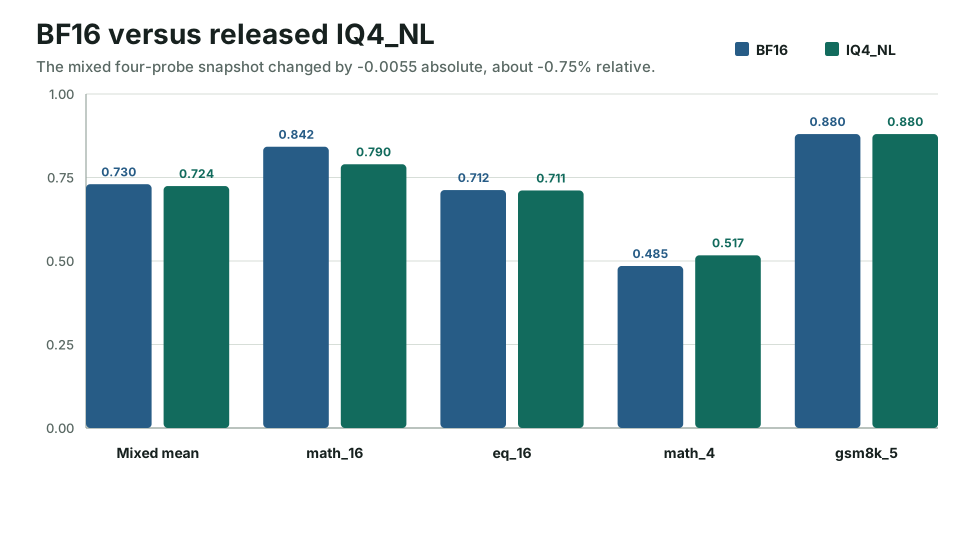
-0.0055 absolute of the BF16 mixed four-probe mean, while the individual probes moved in different directions.Decision
Keep the main release centered on IQ4_NL because the mixed four-probe drop was small relative to the size reduction: about 57.6 GB BF16 GGUF to 16.6 GB IQ4_NL. Runtime speed helped the deployment story, but preserving useful reasoning/coding quality through compression is the core result.
Important Caveat
The 11,14 quant headline is not the same scoreboard. Its two-probe reasoning slice went from 0.854324 BF16 to 0.729260 IQ4_NL, a much larger drop, but that file only used math_4 and gsm8k_5. A separate no-think math_16 + eq_16 file showed a smaller drop, 0.759275 to 0.738754. Defensible read: 11/14 was strong on some probes but more volatile, and it did not win the strict-balanced scan.
Runtime Profile
The model is released for the custom AEON ik-llama fork. That is not packaging trivia; it is part of the tested artifact. The fork carries the Qwen3.6 hybrid and graph-split work needed for this line. In the internal runtime comparison, the recommended custom path decoded at 39.37 tok/s versus 22.51 tok/s for the patched upstream-style comparison; useful speed, but still secondary to the quality-preservation result that made the IQ4_NL file worth releasing.
./build/bin/llama-server \
  -m /path/to/Qwen3.6-27B-AEON-RYS-MaxThinkCoder-IQ4_NL-ik-llama-custom-mixed.gguf \
  -c 65536 \
  -ngl 999 \
  -np 1 \
  -fa on \
  -sm graph \
  --temp 0.7 \
  --jinja \
  --reasoning-format deepseek \
  --reasoning-budget 0
Why the Fork Exists
The project needed custom mixed-GGUF support, Qwen3.6/Qwen3.5 hybrid handling, graph-split stability work, Jinja chat formatting, DeepSeek reasoning extraction, and May 2026 duplicate tool-call filtering.
Long Context
The public profile starts with -c 65536. The same family was also used for 131072 context comparisons. FP32 KV was a conservative validation setting, not a requirement, but the retained 24 GB-class memory reference should be read as the 65536 context profile, not as a 160k memory benchmark.
Practical Single-GPU Deployment
The Q4_NL release is small enough for practical single-GPU deployment. The retained 24 GB-class reference profile is -c 65536 with FP16 KV, which used about 20.8 GiB on an RTX 3090-class card in the logged SignalLatch run. Larger context profiles need more VRAM; a later 32 GB RTX 5090 SignalLatch reference fit -c 160000 -np 2 as two 80k slots at about 27.5 GB. Treat these as deployment reference points, not guaranteed cross-hardware memory benchmarks.
Parallel RAM-Cache And Agent Harness
For OpenAI-compatible agent harnesses, the current fork supports stable slot aliases while still running RAM prompt-cache save/load for those pinned lanes. This is useful when a harness such as OpenCode needs repeated repo context to stay on one lane instead of moving between parallel slots.
./build/bin/llama-server \
  -m /path/to/Qwen3.6-27B-AEON-RYS-MaxThinkCoder-IQ4_NL-ik-llama-custom-mixed.gguf \
  -c 360000 \
  -np 2 \
  -ngl 999 \
  -b 256 \
  -ub 64 \
  -fa on \
  -sm layer \
  -ctk f16 \
  -ctv f16 \
  --temp 0.7 \
  --jinja \
  --reasoning-format deepseek \
  --reasoning-budget 0 \
  --alias qwen36-aeon-rys-15-20-q4nl-p2 \
  -cram 65536
With that alias, configure the client as two separate model names:
qwen36-aeon-rys-15-20-q4nl-p2-slot0
qwen36-aeon-rys-15-20-q4nl-p2-slot1
-np 2creates two parallel slots. The total-ccontext budget is split across those slots.-cramis the RAM prompt-cache budget in MiB and is server-wide, so tune it to the host memory budget.- Keep context checkpoints enabled. Do not pass
--ctx-checkpoints 0when RAM-cache restore is desired. - Use
-sm layerfor the tested two-GPU parallel RAM-cache restore path. On this recurrent/hybrid path,-sm graphdisables the checkpoints needed for actual restore.
The patched fork was verified with an A/B/A prompt sequence on a single slot and on both parallel lanes. The expected server log sequence is created context checkpoint, found better prompt, prompt cache load took ..., and restored context checkpoint. Before the patch, explicit -slot0 / -slot1 requests could pin work to a lane but skipped the prompt-cache save/load path.
| Runtime Check | Setup | Decode | Decision |
|---|---|---|---|
| Recommended custom path | Graph split, long-context deployment profile, FP32 KV validation snapshot. | 39.37 tok/s | Public runtime path; faster in this internal comparison, with the release claim still anchored on quality preservation. |
| Patched upstream-style comparison | Internal standard-typed comparison path, shorter context, layer-style comparison. | 22.51 tok/s | Not released as the public target. |
MTP And Speed Work
The MTP file is real and structurally valid, but it did not replace the default. We kept it because it is useful for runtime research, not because it beat the normal non-MTP file.
| Check | Result | Read |
|---|---|---|
| MTP metadata | qwen35.nextn_predict_layers = 1 | MTP tail exists. |
| MTP tensor coverage | 8 quantizable blk.69 tensors | Patched imatrix collection covered the MTP tail. |
| MTP-aware imatrix | 80 chunks, PPL 4.3762 +/- 0.07886 | Calibration path completed. |
| 512-token quality | 0.166138 score with MTP | Effectively identical to the old MTP GGUF in that suite. |
| 2048-token no-MTP quality on MTP file | worst repeat 59 | Worse repeat penalty than the practical non-MTP default. |
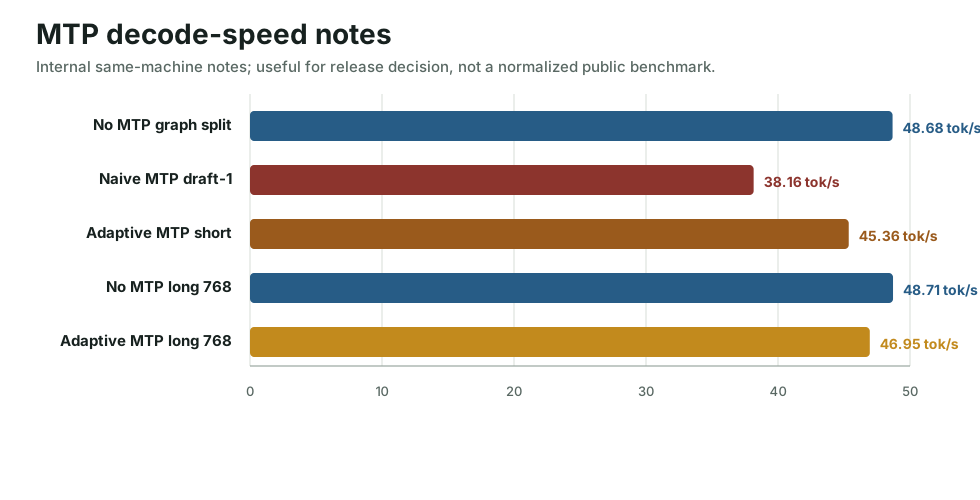
| Speed Check | Decode | Prompt | Read |
|---|---|---|---|
| No-MTP graph split reference | 48.6795 tok/s | 214.9709 tok/s | Final clean matrix reference; still fastest. |
| Naive MTP draft-1 | 38.1550 tok/s | noted in matrix | Acceptance 225/345 = 65.217%. |
| Adaptive MTP short check | 45.3589 tok/s | 208.79 tok/s | Acceptance 158/218 = 72.477%; closer, still not enough to replace default. |
| No-MTP long 768-token check | 48.7140 tok/s | long check | Longer generation still favored no-MTP. |
| Adaptive MTP long 768-token check | 46.9539 tok/s | long check | Acceptance 38/54 = 70.37%; close but still behind. |
Decision
Publish the MTP GGUF as experimental. Keep the non-MTP IQ4_NL file as the default because practical quality and speed still favored it.
Rejected Or Non-Default Variants
Several useful experiments did not become the public default. They are included here because the negative results explain the release shape.
| Variant | Test | Result | Decision |
|---|---|---|---|
11,14 IQ4_NL |
Long-reasoning fair comparison, math_16 + gsm8k_5, 21 questions, 2048 max tokens. |
Same final/any exact rates as 15/20, but much cleaner repetition: worst 4gram repeat 7 vs 47 for 15/20. | This resolves the long-reasoning Q4_NL setting in favor of cleaner 11/14 repetition, but does not replace the selected release without matching evidence across the mixed quant suite, runtime packaging, and practical agent tests. |
| RYS-window mixed-Q8 | Force 46 attention/SSM tensors in layers 15..24 to Q8_0. | File size +3.35%; mean best-rel 0.87299 vs 0.89998 baseline in a 9-item quick paired eval. | Do not replace IQ4_NL. Consider narrower Q8 variants later. |
| Standard llama.cpp-style public file | Internal patched upstream-style comparison path. | Still required special runtime assumptions and was not the main tested target. | Do not present as stock llama.cpp support. |
| MTP default | MTP graph split, graph reuse, adaptive gate, MTP-tail imatrix. | Technically valid but slower or less clean than no-MTP in tested paths. | Publish as experimental only. |
Practical Agent Tests
These checks use the released non-finetuned AEON RYS 15/20 IQ4_NL artifact unless a row explicitly says otherwise. They are practical coding-agent checks, not broad benchmarks. The numbers needed to interpret them are reproduced here; the file paths in the ledger are provenance only.
Scope Boundary
Some practical rows were collected during later SignalLatch and Unsloth comparison work. This page uses only the AEON RYS IQ4_NL base rows. SignalLatch strength-sweep and clean-pass claims belong to the separate fine-tune page.
Five-task Matrix
Base run: AEON RYS IQ4_NL. Setting: temp 0.7, graph split, flash attention, Jinja/DeepSeek, 65536 context. Result: strict pass 1/5, mean 0.550, task scores 0.75, 1.00, 0.25, 0.25, 0.50, timeout-like tasks 4.
Canvas Attempt 1
Base run: AEON RYS IQ4_NL attempt 1. Setting: temp 0.7, 131072 context, FP32 KV, graph split, flash attention. Result: rc=1, 337s, verifier 0.0417 / false, root files: none.
Canvas Retry
Base run: AEON RYS IQ4_NL retry 1. Same task and runtime family. Result: rc=0, 803s, verifier 1.0 / true, complete app files. Read: the base can complete the task, but first-attempt reliability remains a caveat.
| Production Matrix Task | Score | Pass | RC / Time | Verifier Read |
|---|---|---|---|---|
github_mcp_commits_fix_repeat | 0.75 | No | rc=1, 260s | Build, branch schema, branch output, and README checks passed; request path/branch parameter checks failed. |
github_mcp_pr_details_fix | 1.00 | Yes | rc=124, 600s | Correctly used the PR detail endpoint and detail additions/deletions/changed-files fields, but still hit the full timeout. |
local_search_kill_excess_fix | 0.25 | No | rc=124, 600s | Build passed; targeted process-kill behavior was not implemented. |
local_search_search_timeout_fix | 0.25 | No | rc=124, 600s | Build passed; timeout schema and handler propagation were not implemented. |
local_search_web_search_race_fix | 0.50 | No | rc=124, 600s | Multiple engines remained, but the first-success race behavior was not implemented. |
| Canvas Harness Detail | Value Included Here |
|---|---|
| Prompt | Build an isolated Krita-like raster canvas app with layers, brush/eraser, transforms, opacity, and a local AI image-generation stub. |
| Shared settings | Temp 0.7, context 131072, FP32 K/V cache, flash attention, graph split, Jinja, DeepSeek reasoning format, CLAW_MAX_TOKENS=1800, TIMEOUT_SECONDS=900. |
| Retry root files | index.html 3,450 bytes; styles.css 7,062 bytes; app.js 17,551 bytes; README.md 1,033 bytes. |
| Excluded comparison rows | The full later comparison also included SignalLatch IQ4_NL, Unsloth IQ4_NL, and Unsloth Q8_0 rows. Those are not used as evidence for this non-finetuned base release. |
Decision
Keep this release claim narrow: AEON RYS 15/20 IQ4_NL is a viable compressed coding-agent base with practical competence and documented reliability caveats. SignalLatch is a later behavior-finetuned attempt to improve that reliability, not part of the non-finetuned release score.
Implementation Footnotes
The duplicate-window representation is recorded here for transparency, but it is not the headline claim of the release. The main claim remains quantization survival and practical runtime behavior for the tested IQ4_NL file.
Why This Version Stayed Materialized
Materialized tensors kept the HF checkpoint, GGUF conversion, quantization, and downstream fine-tune/LoRA workflows explicit and stable for the tested release.
Future Optimization
A procedural or aliased RYS runtime could reuse source-layer weight buffers and save duplicate-weight memory. That is possible future runtime work, not a change to this already tested release artifact.
Evidence Ledger
This ledger records the source filenames used to reconstruct the page. It is a provenance map, not required reading: the public numeric data needed to understand the release is reproduced above in the tables, charts, captions, and artifact rows.
qwen36_rys_work/README.md records current defaults, directory map, RYS semantics, strict top-6 table, quantization snapshot, GGUF/imatrix paths, and serving notes.
qwen36_aeon_validation/results/aeon_strict_math120.pkl and qwen36_aeon_validation/results/aeon_strict_eq140.pkl.
qwen36_aeon_validation/results/quant_compare_15_20_q4_vs_bf16_math16_eq16_reasoning_math4_gsm8k5_20260426.json.
qwen36_aeon_validation/results/quant_compare_11_14_q4_vs_bf16_reasoning_math4_gsm8k5_20260426.json.
qwen36_rys_work/rys_fair_compare_11_14_vs_15_20/results/q4nl_reason2048_ctx32768_bwrap0349_20260430_123403/.
qwen36_rys_work/aeon_rys_15_20_gguf/mixed_q8_ryswin/README_results.md and latest_quick_eval_results.json.
qwen36_rys_work/aeon_rys_15_20_mtp_gguf/imatrix_mtp_iq4nl/README_results.md.
qwen36_rys_work/mtp_speed_probe/autoresearch_3090/RESULTS_3090_MTP_SPEED_20260501.md and qwen36_rys_work/mtp_rebuild_20260501_151130/final_results.md.
docs/ckpt386-s010-testing-process/evidence/base_q4nl_summary.md. The base task scores, pass flags, return codes, and timings are reproduced in the Practical Agent Tests section.
qwen36_rys_work/aeon_rys_15_20_signallatch_gguf/evidence/canvas_unsloth_comparison_20260505_summary.md. Only the AEON RYS IQ4_NL attempt/retry rows are used for this base-release page; SignalLatch and Unsloth rows are downstream or external comparison context.